I know your tribulation and poverty, but you are rich.
"The preferential option for the poor" is a consept in Catholic social thought (in Protestant too?). It's often linked with liberation theology, but as we can see from this passage, the idea that actual poverty = spiritual wealth is much older than LT.
Here's a bit from an interview with Gustavo Gutiérrez from an issue of America magazine ...
Do you think the “preferential option for the poor” has become an integral part of the Catholic Church’s social teaching? And where did that term come from?
Yes, I do believe that the option for the poor has become part of the Catholic social teaching. The phrase comes from the experience of the Latin American church. The precise term was born sometime between the Latin American bishops’ conferences in Medellín (1968) and in Puebla (1979). In Medellín, the three words (option, preference, poor) are all present, but it was only in the years immediately following Medellín that we brought these words into a complete phrase. It would be accurate to say that the term “preferential option for the poor” comes from the Latin American church, but the content, the underlying intuition, is entirely biblical. Liberation theology tries to deepen our understanding of this core biblical conviction.
The preferential option for the poor has gradually become a central tenet of the church’s teaching. Perhaps we can briefly explain the meaning of each term:
• The term poverty refers to the real poor. This is not a preferential option for the spiritually poor. After all, such an option would be very easy, if for no other reason that there are so few of them! The spiritually poor are the saints! The poverty to which the option refers is material poverty. Material poverty means premature and unjust death. The poor person is someone who is treated as a non-person, someone who is considered insignificant from an economic, political and cultural point of view. The poor count as statistics; they are the nameless. But even though the poor remain insignificant within society, they are never insignificant before God.
• Some people feel, wrongly I believe, that the word preferential waters down or softens the option for the poor, but this is not true. God’s love has two dimensions, the universal and the particular; and while there is a tension between the two, there is no contradiction. God’s love excludes no one. Nevertheless, God demonstrates a special predilection toward those who have been excluded from the banquet of life. The word preference recalls the other dimension of the gratuitous love of God—the universality.
• In some ways, option is perhaps the weakest word in the sentence. In English, the word merely connotes a choice between two things. In Spanish, however, it evokes the sense of commitment. The option for the poor is not optional, but is incumbent upon every Christian. It is not something that a Christian can either take or leave. As understood by Medellín, the option for the poor is twofold: it involves standing in solidarity with the poor, but it also entails a stance against inhumane poverty.
The preferential option for the poor is ultimately a question of friendship. Without friendship, an option for the poor can easily become commitment to an abstraction (to a social class, a race, a culture, an idea). Aristotle emphasized the important place of friendship for the moral life, but we also find this clearly stated in John’s Gospel. Christ says, “I do not call you servants, but friends.” As Christians, we are called to reproduce this quality of friendship in our relationships with others. When we become friends with the poor, their presence leaves an indelible imprint on our lives, and we are much more likely to remain committed.
August 31, 2006


Revelation of John 2:8-11 (Smyrna)
'Write to the angel of the church in Smyrna and say, "Here is the message of the First and the Last, who was dead and has come to life again:
I know your hardships and your poverty, and -- though you are rich -- the slander of the people who falsely claim to be Jews but are really members of the synagogue of Satan. Do not be afraid of the sufferings that are coming to you. Look, the devil will send some of you to prison to put you to the test, and you must face hardship for ten days. Even if you have to die, keep faithful, and I will give you the crown of life for your prize.
Let anyone who can hear, listen to what the Spirit is saying to the churches: for those who prove victorious will come to no harm from the second death."
I know your hardships and your poverty, and -- though you are rich -- the slander of the people who falsely claim to be Jews but are really members of the synagogue of Satan. Do not be afraid of the sufferings that are coming to you. Look, the devil will send some of you to prison to put you to the test, and you must face hardship for ten days. Even if you have to die, keep faithful, and I will give you the crown of life for your prize.
Let anyone who can hear, listen to what the Spirit is saying to the churches: for those who prove victorious will come to no harm from the second death."
August 30, 2006
Second Post: Angels and Churches
My post got screwed up some way and wouldn't allow comments. So I deleted it and here it it again. (I'll try to reproduce the two comments)
John used this device to separate the church (a principality) from the angel (a spiritual force). We might well emulate that in our own thoughts and feelings. When the angel is remonstrated with, it may suggest that a foreign spirit has entered into and threatens to dominate the church. We all know of cases where this has happened, though not necessarily fatal.
We also all, at least I, go to the far country sometimes and need to "come to ourselves". The letters to the Churches seem to be to a large degree toward that purpose.
I've been away, so for the whole morning I have interespersed comments on the posts of the last five days. Read if you get a chance.
John used this device to separate the church (a principality) from the angel (a spiritual force). We might well emulate that in our own thoughts and feelings. When the angel is remonstrated with, it may suggest that a foreign spirit has entered into and threatens to dominate the church. We all know of cases where this has happened, though not necessarily fatal.
We also all, at least I, go to the far country sometimes and need to "come to ourselves". The letters to the Churches seem to be to a large degree toward that purpose.
I've been away, so for the whole morning I have interespersed comments on the posts of the last five days. Read if you get a chance.
August 26, 2006
More Jacques Ellul (pg 129)
" 'Remember from what you have fallen.' Because love is union itself with God for the love of God. The works are of value only if they are the fruit of love itself working in us. They have no other value, no intrinsic value, not even the practice of justice or purity... The Lord does not put out the flame but changes the place of the lampstand; which is to say that the flame of truth and love is given to someone else. From that time this church will remain a church apparently alive but in reality empty. To us, it would seem that Jesus Christ is interested in keeping a solid, orthodox church, long at this place, in her place. Not at all! He is prepared to let her fall because the only thing that matters is that the Church keep the love of God. Better to cease having a church than to have a church of traditions, of good works, of institution without the love of God....The task then is to find again the first works, which is to say those that emanate directly, spontaneously, from love, those which were a beautiful ripe fruit, and not a difficult duty. It is a matter then of no longer putting her own works in the place of God."
The stick and the carrot / crystal
... repent, and behave as you did at first, or else, if you will not repent, I shall come to you and take your lamp-stand from its place ... those who prove victorious I will feed from the tree of life set in God's paradise.
I looked at this reading as if it was about a relationship, and it seems sort of disfunctional to me. Love can't be coerced, doesn't respond to threats or bribes. This is a very different relationship than that shown in the story of the prodigal son, for instance. It's hard for me to believe this reading is "inspired", or if it is, that it is free from the writer's ax grinding interpretations.
- The Return of the Prodigal Son by Sir Edward John Poynter
I looked at this reading as if it was about a relationship, and it seems sort of disfunctional to me. Love can't be coerced, doesn't respond to threats or bribes. This is a very different relationship than that shown in the story of the prodigal son, for instance. It's hard for me to believe this reading is "inspired", or if it is, that it is free from the writer's ax grinding interpretations.
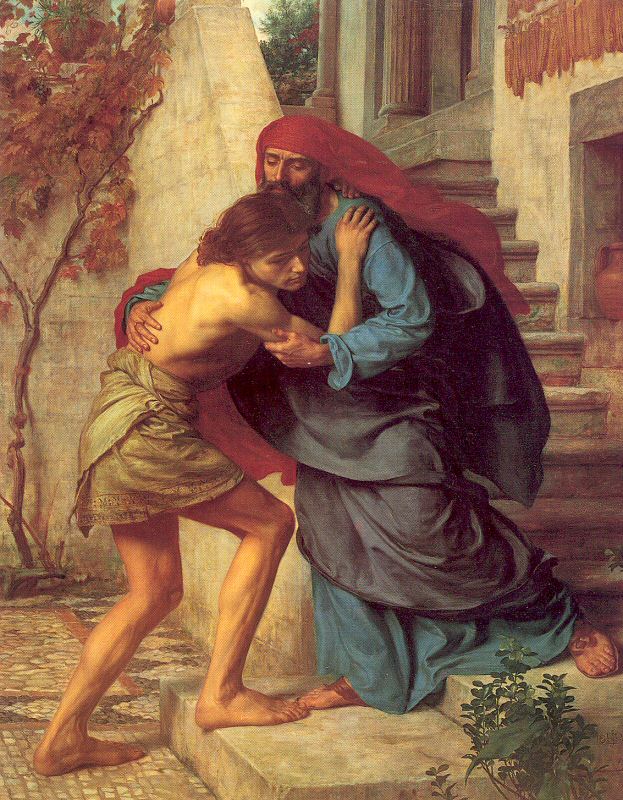
- The Return of the Prodigal Son by Sir Edward John Poynter
Subscribe to:
Posts (Atom)