From one of my poems on another site...
"...Don't demand peace
or call loudly for justice.
Beg mercy; our nation's trial
is now in the sentencing phase..."
This has been on my mind for a very long time. It's a cliche when people say they don't want some particular American atrocity "done in my name." It's a cliche because it happens and happens over and over again.
There's a crash coming. We've worked hard for it; we deserve it; and unless all the signs of our times have just been kidding, we're going to get it.
I don't want to carry this discussion all by myself; I didn't join up here to be a blog of my own. But we can't quit now; Babylon ain't even fallen yet.
This book takes the justice of the Hebrew prophets and ups the ante. Yahweh was just angry because he loved his people and they weren't giving him the attention he wanted. That's a very human thing. What we've been getting here is more like Yahweh vs Pharoah. ~'Plagues coming, armoured locusts tomorrow followed by occasional fire-breathing horses, clearing by sometime next year.' The specific details may have been symbolic of something in our condition, but mostly we get this impression that God doesn't like us. And that puts people off; I can't blame them for that.
Jacques Ellul keeps finding love, hope, and good stuff in all this.
In my own life, so far as I feel myself part of this world, I find a continuing tension between love and hope vs the vast public spectacle of corruption triumphant.
Jacques considers the powers beaten, from the moment of Incarnation... "But they still have a considerable force among men. They can cause men to perish; upon the earth they can accuse and destroy.
"Why then this delay?... Why is there not an immediate and total victory of God? ... First of all, if there were a total victory, this would be once more the expression of the absolute, unlimited power of God. Once more there would be a competition of powers. Now this explosion of power is exactly what the Tempter proposes. He continually provokes God to combat. But if this takes place, God is no longer love.
"The way decided by God in the Incarnation is the triumph of love; but precisely this love which gives itself, abandons itself, delivers itself up, is not that which kills....
"But the other aspect of this delay... is the time of testing for humanity; the time of the desert... In other words, the issue here is knowing if man is going to follow Jesus, is going to enter into the plan of God, is going to accept this unity with God.... The time of the desert is the time when man is deprived of all his natural resources, the possibilities and protection of civilization, when he is truly 'unchained', but with all the risks that that involves. The time of the desert is that when man has strictly no other support, no other assurance than the grace of God."
Maybe you don't feel yourself in that position yet?
Certainly, as I've been trying to say elsewhere, this is not testing us "to see if we make the cut" to get into the best neighborhood in the Afterlife. Perhaps the attempt to pass ourselves through such a test may help us see the absurdity of the very idea.
This is a spot quiz, not for the grade but for learning. Are we in unity with God yet? Not entirely? Why not?
This reminds me a little of my first notion of Friends, many years ago, that we all would march around obeying our consciences in perfectly idolatrous, triumphant integrity. I went to the nearest worship group, sat there a few minutes, felt a presence standing by the door, asking: "Forrest! What are you doing, trying to hide with the good people?"
I think I have learned to know God much better, since then. And it has never gone quite as I've expected.
How can we be under Judgement?--as I feel we must be--and yet be loved, held safe, protected even from our own inadequacies? Because we've bribed the Judge. Because the Judge is (among other things) the Defendents. Because the object of this trial is not to punish us, but to lead us toward doing that one right thing, to put our trust in God at work in and around us, at this and every moment.
November 06, 2006


still much for discussion--if we're up to it (?)
While we're still here...
You left out verse #14: "The second woe has now passed. But the third is yet to come."
It's rather difficult to pinpoint what that third woe is. Jacques Ellul thinks it's the Incarnation. God becomes a mere human, thereby resigns his absolute power over the universe.
I don't think this Greek distortion of a Hindu notion had entered the author's essentially Jewish mind. For him, as for Paul, I think Jesus is still up there "at the right hand of God," in the royal favor and enjoying ultimate authority, but still distinct from God. But Jacques Ellul, thousands of years later, finds the doctrine there, and who can say that God is only active in the writing?--and not in our later misunderstandings...?
"To the exact degree that the man Jesus is in perfect and constant accord with the will of the Father, that it is not a matter of servile obedience to the law but of perfect response of love to love, to the degree that Jesus is constantly free to be other than God and never-the-less is constantly the voluntarily expression of the will of God, then there is no longer any possible role for [the] powers...
There can no longer be accusation of men before God or separation of men from God (and that is why Jesus is designated the Savior.)
"But these powers are not abolished. They have only lost their decisive power, their power to prevail and to establish definitively chaos or rupture. For a rupture on the part of God--meaning that God would reject humanity--would end in him condemning himself and would be a victory of the powers.
"When there is talk, somewhat thoughtlessly, of the judgement of God, with condemnation and damnation for certain men (and for some theologians, the immense majority of men) it is completely forgotten that this would be not the expression of the justice of God but, rather, the success of the infernal powers. If God condemns, he does what Satan suggests. If he delivers the creation to destruction, the Devil has finally succeeded in his work of breaking decisively the relation between the Creator and the creation. Thus the 'apocalyptic' judgement, which is too often depicted, is not at all the realization of the justice of God but of the victory of the infernal powers.
"And we note in passing that the justice, which (it is declared) demands the judgement of God, is in reality a juridicial concept issuing from the interpretation of the Roman law. That has nothing to do with what the Old Testament calls justice, nor with what Jesus shows us as being the justice of the Father (by example, the workers of the eleventh hour or the parable of the talents.)"
November 01, 2006
The Time Has Come
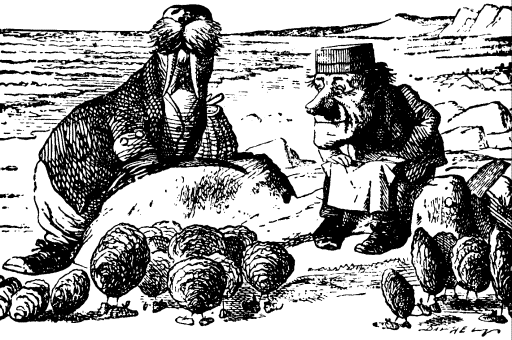
the Walrus said,
"To talk of many things:
Of shoes -- and ships -- and sealing-wax --
Of cabbages -- and kings --
And why the sea is boiling hot --
And whether pigs have wings."
We have come to a point in our original agenda, where we would reconnoitre the lay of the land so to speak and determine whether or nay we might continue in this project. Methinks energies have dropped off -- though blogger has been on the fritz on and off for about a week and commenting may have been difficult. So maybe I misread the circumstances.
Kindly check in with how we be with Revelation. And if some other tome would move you -- suggest it.
October 29, 2006
Seventh Trumpet Sounds/Revelation 11:15-19
Then the seventh angel blew his trumpet, and voices could be heard shouting in heaven, calling, The kingdom of the world has become the kingdom of our Lord and his Christ, and he will reign for ever and ever.
The twenty-four elders, enthroned in the presence of God, prostrated themselves and touched the ground with their foreheads worshipping God with these words,
We give thanks to you, Almighty Lord God, He who is, He who was, for assuming your great power and beginning your reign. The nations were in uproar and now the time has come for your retribution, and for the dead to be judged, and for your servants the prophets, for the saints and for those who fear your name, small and great alike, to be rewarded. The time has come to destroy those who are destroying the earth.
Then the sanctuary of God in heaven opened, and the ark of the covenant could be seen inside it. Then came flashes of lightning, peals of thunder and an earthquake and violent hail.
October 26, 2006
Revelation 11:1-14
Then I was given a measuring rod like a staff, and I was told, "Come and measure the temple of God and the altar and those who worship there, but do not measure the court outside the temple; leave that out, for it is given over to the nations, and they will trample over the holy city for forty-two months. And I will grant my two witnesses authority to prophesy for one thousand two hundred sixty days, wearing sackcloth." These are the two olive trees and the two lampstands that stand before the Lord of the earth. And if anyone wants to harm them, fire pours from their mouth and consumes their foes; anyone who wants to harm them must be killed in this manner. They have authority to shut the sky, so that no rain may fall during the days of their prophesying, and they have authority over the waters to turn them into blood, and to strike the earth with every kind of plague, as often as they desire. When they have finished their testimony, the beast that comes up from the bottomless pit will make war on them and conquer them and kill them, and their dead bodies will lie in the street of the great city that is prophetically called Sodom and Egypt, where also their Lord was crucified. For three and a half days members of the peoples and tribes and languages and nations will gaze at their dead bodies and refuse to let them be placed in a tomb; and the inhabitants of the earth will gloat over them and celebrate and exchange presents, because these two prophets had been a torment to the inhabitants of the earth. But after the three and a half days, the breath of life from God entered them, and they stood on their feet, and those who saw them were terrified. Then they heard a loud voice from heaven saying to them, "Come up here!" And they went up to heaven in a cloud while their enemies watched them. At that moment there was a great earthquake, and a tenth of the city fell; seven thousand people were killed in the earthquake, and the rest were terrified and gave glory to the God of heaven. The second woe has passed. The third woe is coming very soon.
Subscribe to:
Posts (Atom)