I saw a page at Crieghton University's site on praying with our imaginations, or Ignatian contemplation - Contemplating the Call of Matthew ...
“Why does your teacher eat with tax collectors and sinners?” When Jesus saw Matthew, sitting at his customs table, Jesus must have seen how the people despised this tax collector. Jesus had to sense that this kind of resentment and rejection did things to a tax collector. He had to immediately feel compassion on Matthew and what it had done to him. Had it made him defensive and thick skinned? Had he become gruff and insensitive to others? Did he bark and push others away?
I imagine that the first thing Matthew noticed was how Jesus was looking at him. Could it have been that the first experience Matthew had of Jesus was that Jesus was simply looking at him in a way no one had ever looked at him? When their eyes met, Matthew must have seen love and compassion, not blame and judgment. Jesus did not look on him with hate and contempt. Jesus simply looked at him with care.
As I picture the scene, Matthew immediately sensed that Jesus somehow understood the predicament he was in. He got himself into this and he'd not been an attractive character at all. He played the role people had put him in. But, Jesus didn't fix him in that role somehow. Before he uttered a word, Jesus' eyes must have said to Matthew, "I know this isn't really you. I understand how much playing this role is distorting you, souring you, hardening you." It was as though Jesus' face, and the sadness it revealed, reflected the sadness in Matthew's heart.
"Follow me." The words must have made their ways straight to Matthew's heart. Never had his heart been so opened by such understanding, compassion and loving acceptance. For a moment, he must have thought, "Me? I'm just a ... I can't change ... I'm stuck here ... And, what'll they say about ..." But, those protests surely were replaced with something responding from deep inside that welcomed this call, this liberation, this vote of confidence more than anything in the world. Without a word, with their eyes still locked in that communication of intimacy, Matthew's heart said, "Yes! Amen! I'm yours!" Nothing else had a hold on him. There were no excuses, doubts or fears. Matthew had been healed as he had been called. His yes was his surrender to being loved.
Can we look up from our own custom table today and see Jesus looking at us with compassion and love? He knows and understands whatever has us locked into roles, images, patterns that aren't very attractive and that we don't really like about ourselves. Can we let ourselves experience and feel his love? On the other side of that loving acceptance, there's a freedom to imagine him calling us today, in our situation, and say "Follow me."
December 11, 2006


December 10, 2006
including the out caste
Gandhi -- it is said -- liked Jesus very much but found Christians a bit hard to deal with at times. The Jesus of the synoptic traditions -- Mark and Q -- builds his ragtag army out of the rabble that good clean folks would rather not associate with. He also seems to go out of his way to touch lepers and others that would contaminate him from a cultic perspective. I imagine that's what Gandhi found so endearing about him.
So, how do we, people of faith, cope with this witness today?
A minority of self-identified Christians (of which I am NOT one) have committed themselves to direct contact and interaction with the poorest of the poor. Mother Teresa and Oscar Romero are only two prominent names that most might recognize. But there are thousands of others who do not make the cultural radar including many whose motivations are ideological rather than faith-based, such as the Food Not Bombs networks.
But while these folks are legion they remain a minority. Christianity has become a quiet middle-class church rather than a ratty social movement. We deal with the poor and the sinners with social programs that alleviate the suffering but don't particularly include the out castes into our social circles.
Jesus did not feed the poor. He didn't create social programs, food banks, counselling centres. He hung out with folks, when to street parties, taverns and likely brothels.
When you give food to the hungry, they call you a saint. But when you ask why the hungry have no food, they call you a communist.
December 09, 2006
Gospel According to Mark 2:14-17
2:14 As Jesus went on his way, he saw Levi the son of Alphaeus sitting at his desk in the tax office and he said to him, "Follow me!"
2:15-16 Levi got up and followed him. Later, when Jesus was sitting at dinner in Levi's house, a large number of tax-collectors and disreputable folk came in and joined him and his disciples. For there were many such people among his followers. When the scribes and Pharisees saw him eating in the company of tax-collectors and outsiders, they remarked to his disciples, "Why does he eat with tax-collectors and sinners?"
2:17 When Jesus heard this, he said to them, "It is not the fit and flourishing who need the doctor, but those who are ill. I did not come to invite the 'righteous', but the 'sinners'.
December 04, 2006
gospel according to mark 2:1-13
Faith at Capernaum
2:1-5 When he re-entered Capernaum some days later, a rumour spread that he was in somebody's house. Such a large crowd collected that while he was giving them his message it was impossible even to get near the doorway. Meanwhile, a group of people arrived to see him, bringing with them a paralytic whom four of them were carrying. And when they found it was impossible to get near him because of the crowd, they removed the tiles from the roof over Jesus' head and let down the paralytic's bed through the opening. And when Jesus saw their faith, he said to the man on the bed, "My son, your sins are forgiven."
2:6-7 But some of the scribes were sitting there silently asking themselves, "Why does this man talk such blasphemy? Who can possibly forgive sins but God?"
2:8-11 Jesus realised instantly what they were thinking, and said to them, "why must you argue like this in your minds? Which do you suppose is easier - to say to a paralysed man, 'Your sins are forgiven', or 'Get up, pick up your bed and walk'? But to prove to you that the Son of Man has full authority to forgive sins on earth, I say to you," - and here he spoke to the paralytic - "Get up, pick up your bed and go home."
2:12 At once the man sprang to his feet, picked up his bed and walked off in full view of them all. Everyone was amazed, praised God, and said, "We have never seen anything like this before."
2:13 Then Jesus went out again by the lake-side and the whole crowd came to him, and he continued to teach them.
December 01, 2006
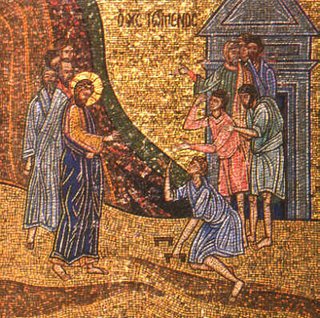
Mark 1:40-41
A leper came to him (and kneeling down) begged him and said, "If you wish, you can make me clean." Moved with pity, he stretched out his hand, touched him, and said to him, "I do will it. Be made clean."
Two interesting things about this reading ... one is that there's some question about the Greek word used to describe Jesus' emotion when he heals the leper ... the other is that Jesus touched the leper, when doing so would have made him "unclean" as well.
Here's some of a Sermonwriter article ...
V. 41 presents us with a difficult translation problem. Most manuscripts say that Jesus was filled with pity or compassion (Greek: splanchistheis), but others say that he was angry (Greek: orgistheis). Compassion makes more sense in this context, and some good manuscripts use splanchistheis. However, there are also reasons to read anger (orgistheis) here .... Jesus is trying to maintain a proper balance between teaching and healing, the two primary forms of his ministry in the first half of this Gospel. For the most part, people are drawn to him by his healing miracles, and often fail to see his deeper spiritual dimension .... The leper's plea forces him to choose between mission and compassion − to compromise one or the other ...
And ...
If Jesus can heal the man by touch, presumably he could also heal him without touching him. His touch seems reckless, because touching the leper should contaminate Jesus (both medically and spiritually). However, in this case, it is not the leper who is contagious, but Jesus. The leper does not transmit his uncleanness to Jesus, but Jesus transmits his wholeness and holiness to the leper and makes him clean (medically, spiritually, and socially) .... In this Gospel, we will read about Jesus touching or associating with other people in ways that would potentially defile him − tombs and swine (5:1-20); a hemorrhaging woman (5:25-27); a corpse (5:41); Gentiles and unclean spirits (7:24-26). In each instance, he transmits his wholeness and holiness rather than the other way around ...
Two interesting things about this reading ... one is that there's some question about the Greek word used to describe Jesus' emotion when he heals the leper ... the other is that Jesus touched the leper, when doing so would have made him "unclean" as well.
Here's some of a Sermonwriter article ...
V. 41 presents us with a difficult translation problem. Most manuscripts say that Jesus was filled with pity or compassion (Greek: splanchistheis), but others say that he was angry (Greek: orgistheis). Compassion makes more sense in this context, and some good manuscripts use splanchistheis. However, there are also reasons to read anger (orgistheis) here .... Jesus is trying to maintain a proper balance between teaching and healing, the two primary forms of his ministry in the first half of this Gospel. For the most part, people are drawn to him by his healing miracles, and often fail to see his deeper spiritual dimension .... The leper's plea forces him to choose between mission and compassion − to compromise one or the other ...
And ...
If Jesus can heal the man by touch, presumably he could also heal him without touching him. His touch seems reckless, because touching the leper should contaminate Jesus (both medically and spiritually). However, in this case, it is not the leper who is contagious, but Jesus. The leper does not transmit his uncleanness to Jesus, but Jesus transmits his wholeness and holiness to the leper and makes him clean (medically, spiritually, and socially) .... In this Gospel, we will read about Jesus touching or associating with other people in ways that would potentially defile him − tombs and swine (5:1-20); a hemorrhaging woman (5:25-27); a corpse (5:41); Gentiles and unclean spirits (7:24-26). In each instance, he transmits his wholeness and holiness rather than the other way around ...

Subscribe to:
Posts (Atom)